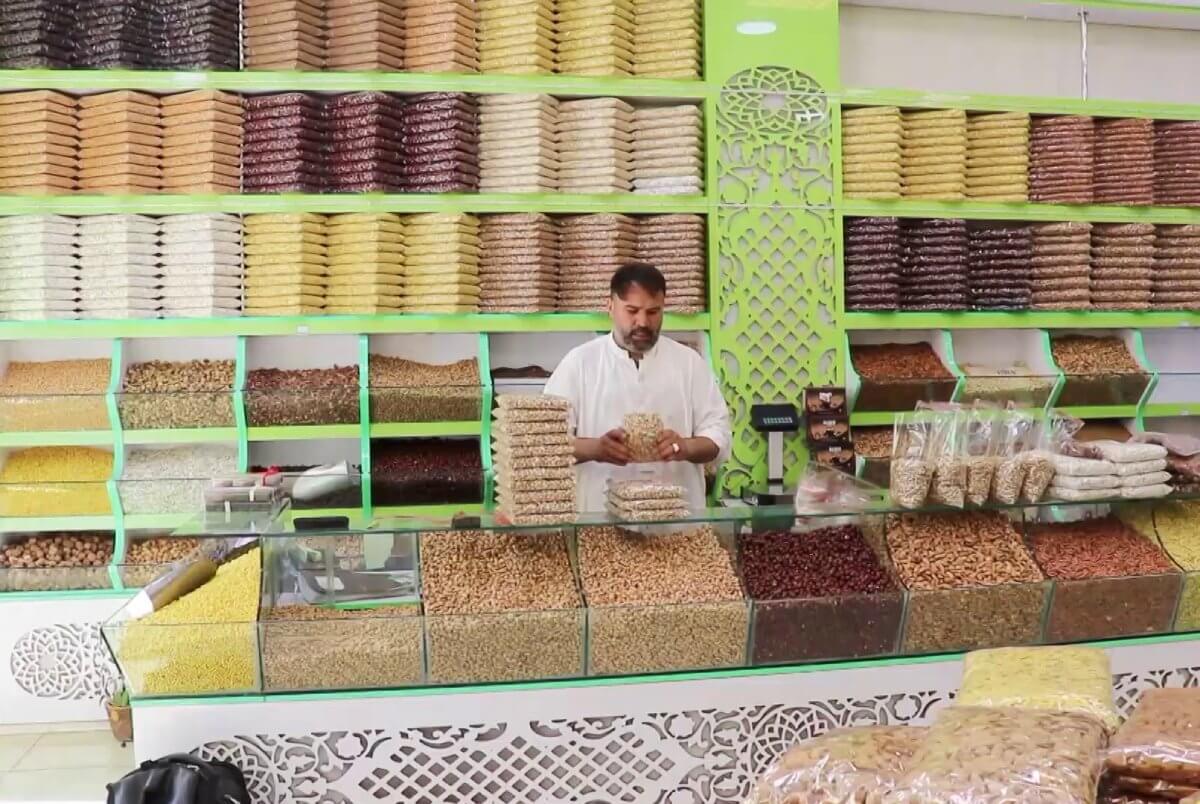
 The Herat Chamber of Commerce and Investment says that 3,140 metric tons of dried fruit have been exported from Afghanistan to various countries over the past two months.
The exports were valued at $7.6 million.
Mohammad Yousuf Amin, Executive Director of the Herat Chamber of Commerce and Investment, said: “Dried fruits have been exported to Iraq, Austria, the United Arab Emirates, neighboring countries, and several European countries. The exports include raisins, almonds, pistachios, dried figs, watermelon seeds, and other dried fruits.”
Afghan dried fruits are currently sold in around 20 countries worldwide, with the number of buyers increasing as product quality and packaging improve.
Exporter Mohammad Usman Ansari said: “In previous years, Afghan dried fruits were exported in sacks and packaged abroad. Now, traders in Herat package these products in a high-quality and professional manner, which has gained acceptance in international markets.”
Another exporter, Mehdi Akrami, said: “Afghanistan’s dried fruit exports are increasing every year. A few years ago, we exported to only five or six countries, but now our products reach nearly 20 countries.”
The Herat Chamber of Commerce and Investment says the country’s dried fruit exports have increased by 5% compared to last year.
Despite the growth, Afghanistan’s share of the global dried fruit market remains relatively small.
Economic analyst Nazir Ahmad Sadid said: “Afghan dried fruits have become one of the world’s important traded commodities, but challenges remain. Today, consumers do not buy only the product; they also value packaging, credibility, branding, and marketing. This is one of the reasons why Afghanistan’s share of the market is smaller than that of major exporters such as Türkiye, Iran, the United States, China, and Uzbekistan.”
With its four distinct seasons and favorable climate, Afghanistan is considered well-suited for dried fruit production.
Most of the country’s dried fruits are produced organically in orchards and agricultural areas, making them attractive to international buyers.
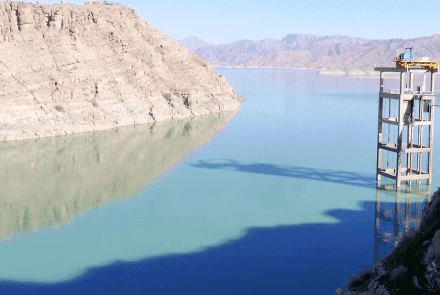 Da Afghanistan Breshna Sherkat (DABS), Afghanistan’s power company, stated recent rainfall has significantly increased water levels in the country’s hydropower dams, resulting in higher electricity generation.
According to the company, nearly 90 percent of the water required for hydropower dams has been supplied, leading to increased electricity production and improved power distribution for citizens.
Mohammad Sadiq Haqparast, the company’s spokesperson, said: “For the first time in the past 17 years, Afghanistan has experienced such extensive rainfall. As a result, hydropower dams have been filled with water, electricity generation has increased, and citizens are receiving better electricity services.”
Meanwhile, some residents have welcomed the relative improvement in electricity supply but say that power shortages and outages still persist in certain areas.
Saddam, a resident of Kabul, said: “Electricity is better than before, but more attention is needed because some citizens are still facing power outages.”
Another Kabul resident, Gul Rahman, added: “Power outages increase during the summer. We ask Breshna and the relevant authorities to make efforts to reduce this problem.”
Some economic analysts say increased hydropower generation can help reduce costs, improve irrigation for agricultural land, and better meet the electricity needs of citizens.
Abdul Nasir Rashtia, an economic analyst, said regarding the importance of rainfall for agriculture and energy production: “Increasing electricity generation and building dams can support our agriculture while also helping meet the country’s energy needs.”
This comes as the Ministry of Energy and Water had previously announced continued efforts to improve water resource management and increase the country’s electricity generation capacity.
 Local officials in Herat say the establishment of commercial orchards has increased significantly in recent years across the province.
According to local statistics, more than 1,000 hectares of commercial orchards in Herat are now producing fruit, with fresh produce being exported to several countries.
Bashir Ahmad Bahadari, head of the Herat Chamber of Agriculture and Livestock, said: “These orchards can play a significant role in increasing fruit exports. We have many traditional orchards in Herat where several types of fruit, including grapes, are grown together. However, the newly established orchards are primarily dedicated to one or two types of fruit, particularly grapes, which have strong export potential and can also be processed into high-quality raisins.”
A number of orchard owners say they have invested heavily in developing these orchards and are calling for greater support and improved facilities to export their products to international markets.
Ghulam Mahboob, an orchard owner, said: “We expect the government to help create markets for our products so that we can sell our fruits, including grapes and raisins.”
Another orchard owner, Qudratullah, said: “We urge the government to facilitate land and air transport routes for our exports. We need access to foreign markets.”
The expansion of commercial orchards has also contributed to an increase in fresh fruit exports.
According to the Herat Chamber of Commerce and Investment, 24 metric tons of fresh fruit were exported from Herat to India during the past two months.
Agricultural expert Abdul Shakoor Ahrari said: “By improving the quality of domestic products, we can compete with neighboring countries that produce similar goods and supply higher-quality products to both domestic and international markets.”
Local statistics indicate that Herat has more than 28,000 hectares of fruit orchards.
A variety of fruits, including grapes, figs, apples, peaches, apricots, cherries, pomegranates, and other orchard products, are cultivated and harvested across the province.
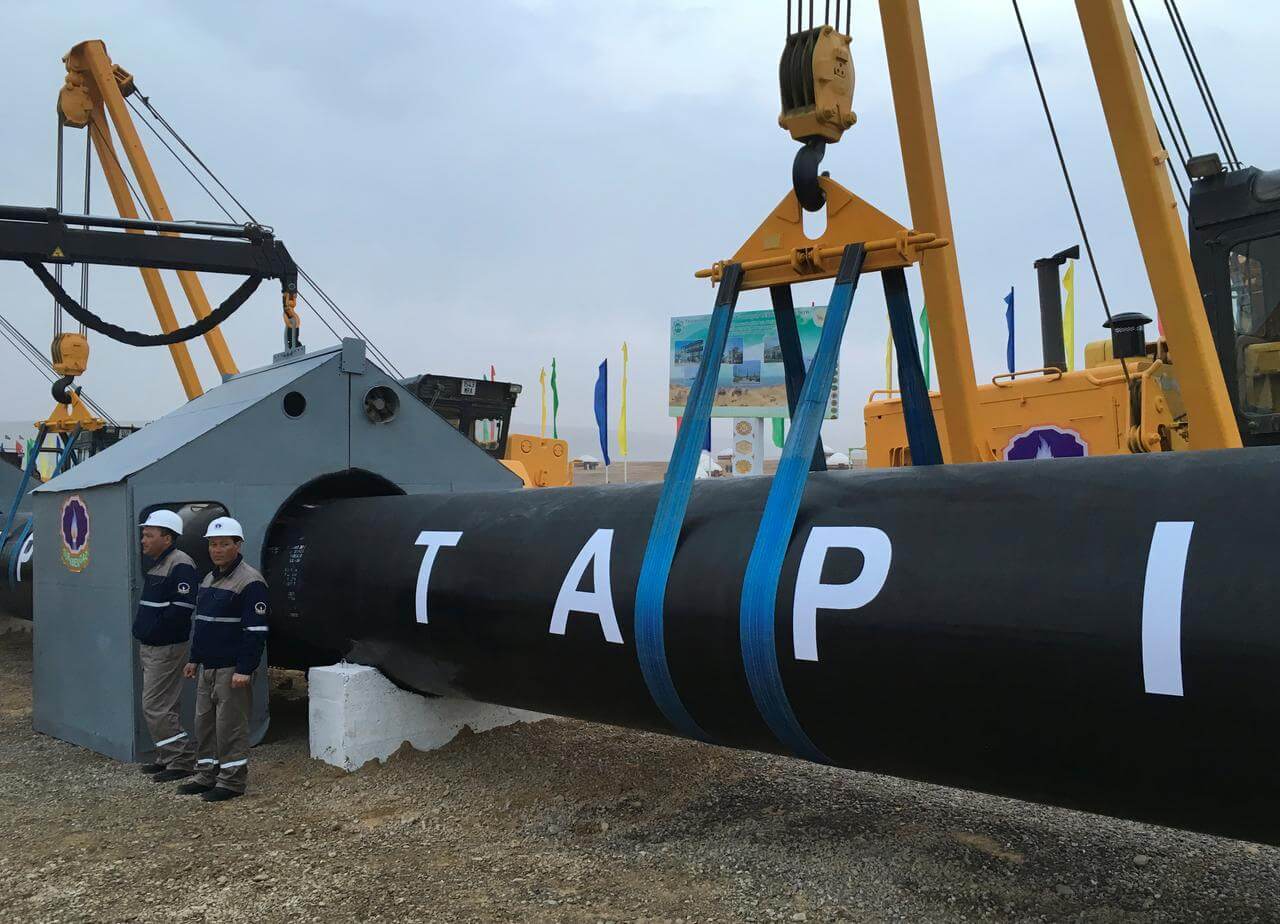 Construction work on the TAPI gas pipeline project in Herat Province is progressing rapidly, with 52 percent of the project completed so far, according to the Ministry of Mines and Petroleum.
The ministry said technical activities, including route preparation, transportation of equipment, welding, and pipeline installation, are continuing steadily. According to the ministry, 80 kilometers of gas pipeline have already been installed, while a 126-kilometer corridor has been prepared for project implementation.
Economic analyst Abdul Shakoor Hadawal said the TAPI pipeline, which runs from Turkmenistan to India, is one of the region’s most significant economic projects. He noted that, in addition to creating employment opportunities for thousands of people, the project will provide millions of people in Afghanistan, Pakistan, and India with access to natural gas.
In addition, 108 kilometers of access and monitoring roads have been constructed, and excavation work has been completed along 51 kilometers of the route, including the underground installation of 36.3 kilometers of pipeline.
Officials added that the transportation of equipment and pipes to the project site is ongoing, with more than 72 additional kilometers of pipeline already delivered.
Economic analyst Sir Quraishi said that upon completion, the project will transport nearly 33 billion cubic meters of natural gas annually from Central Asia to South Asia. He added that the project holds particular economic and political significance for Afghanistan and could become an important source of revenue and regional opportunities for the country.
The TAPI pipeline is regarded as one of the region’s most important energy and transit projects. Once completed, Afghanistan is expected to benefit not only from new economic opportunities but also from substantial transit revenues. The first phase of the project in Herat is scheduled to be completed by this winter.
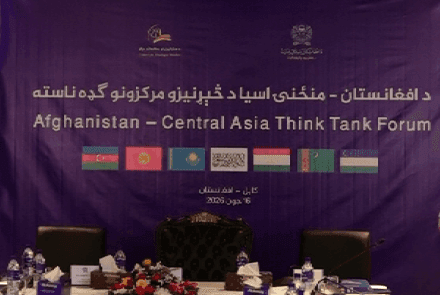 In recent years, Afghanistan has sought to expand its economic and trade ties with Central Asian countries and the Caucasus.
Uzbekistan, Tajikistan, Kazakhstan, Kyrgyzstan, Turkmenistan, and Azerbaijan are among the countries cooperating with Afghanistan in trade, energy, transport, and infrastructure development.
In this context, delegations from these countries traveled to Kabul to participate in the first meeting of the “Strategic Studies Centers and Think Tanks of Afghanistan and Central Asia, Including the Republic of Azerbaijan,” where participants discussed ways to strengthen regional cooperation with Afghanistan.
Addressing the meeting, Amir Khan Muttaqi, Acting Foreign Minister of the Islamic Emirate of Afghanistan, said that Afghanistan’s relations with Central Asian countries and Azerbaijan have expanded in recent years, creating new opportunities for regional and economic cooperation.
Muttaqi added: “As a natural bridge between Central Asia and South Asia, Afghanistan has significant potential for regional connectivity. Projects such as CASA-1000, TAPI, TAP, the Lapis Lazuli Corridor, the Afghan-Trans railway project, and other regional transit routes and joint initiatives should be supported through comprehensive economic studies, forward-looking planning, and research-based assessments.”
Uzbekistan is considered one of Afghanistan’s most important economic partners in Central Asia and holds the largest share of Central Asia’s trade with Afghanistan.
Economic cooperation between Afghanistan and Uzbekistan includes:
- Bilateral trade volume: $1.5 billion, with a target of increasing it to $5 billion.
- Major joint projects: the Hairatan–Mazar-e-Sharif railway and the Trans-Afghan railway project.
- Investments: $1 billion in the Toti Maidan gas project and $240 million in electricity transmission infrastructure.
- Trade agreements worth more than $5 billion signed in the past eight months.
Turkmenistan is also one of Afghanistan’s key energy partners and is involved in the region’s largest energy transmission projects with Afghanistan.
Economic cooperation between Afghanistan and Turkmenistan includes:
- Bilateral trade volume: more than $900 million.
- Joint projects: the TAPI gas pipeline, electricity transmission projects, the Torghundi–Herat railway, and fiber-optic connectivity.
- Investments: $12 million in the Torghundi–Herat railway project.
- Cooperation in the development of border and transit infrastructure.
Kazakhstan is one of Afghanistan’s largest suppliers of wheat and grain and plays a significant role in the country’s food security.
Kazakhstan aims to increase bilateral trade with Afghanistan to $3 billion, and delegations from the country have visited Kabul to advance this goal.
Economic cooperation between Afghanistan and Kazakhstan includes:
- Bilateral trade volume ranging from $500 million to nearly $1 billion.
- One of Afghanistan’s largest suppliers of wheat and grain.
- A major contributor to Afghanistan’s food needs.
- A pledged investment of $500 million in the Torghundi railway sector.
Ahmad Tawfiq Dawari, adviser to the Afghanistan Chamber of Commerce and Investment, highlighted the importance of economic cooperation with Central Asian countries, saying: “Afghanistan currently uses Central Asia as a vital trade corridor, with a significant portion of our commerce reaching Russia and other countries through these routes.”
Tajikistan and Kyrgyzstan cooperate with Afghanistan in energy, transit, and regional projects, with CASA-1000 being one of the most important joint initiatives. However, trade and investment between Afghanistan and Kyrgyzstan remain limited.
Azerbaijan’s economic engagement with Afghanistan remains modest, with no significant investments reported so far. Cooperation is mainly focused on transit through the Caspian Sea and linking Afghanistan to Caucasus and European transport corridors.
 Da Afghanistan Bank has announced a ban on the entry of Iranian and Pakistani currencies into Afghanistan.
The central bank said the measure is aimed at preserving the value of the afghani and has urged traders, money exchangers, transport companies, and travelers to refrain from bringing these currencies into the country.
The bank emphasized that the afghani has maintained relative stability compared with many regional currencies, adding that protecting the national currency is essential for strengthening the country’s economy.
Haseebullah Noori, spokesperson for the bank, said: “This measure has been taken to promote the use of the afghani and prevent the use of foreign currencies in trade transactions with countries in the region and beyond.”
Previously, the Iranian toman and Pakistani rupee were commonly used in some areas along Afghanistan’s borders with Pakistan and Iran, particularly in trade transactions with the two countries.
Some economic analysts believe that, if implemented effectively, the policy could strengthen the position of the afghani, reduce fluctuations in the currency market, and increase public confidence in the national currency.
Sayed Masoud, an economic analyst, said: “The afghani holds strong value in the region. In fact, the currencies of neighboring countries are considered soft currencies compared with the afghani.”
Shamsurrahman Ahmadzai, another economic analyst, said: “This step should have been taken earlier, but now is still a good time to stop the use of these currencies so that the afghani can maintain its value and gain greater recognition internationally.”
The relative stability of the afghani in recent months has been described by officials of the Islamic Emirate as one of the country’s key economic achievements.
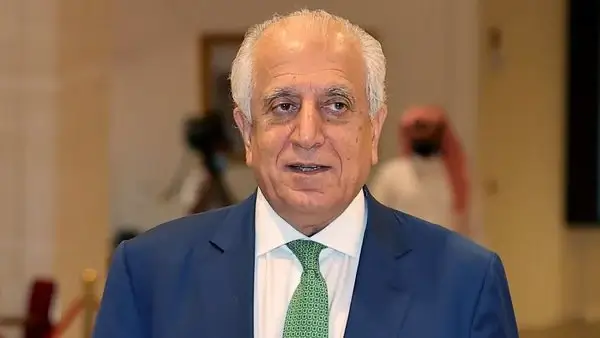 Almay Khalilzad, former U.S. special representative for Afghanistan reconciliation, has welcomed Uzbek President Shavkat Mirziyoyev’s support for the Afghan–Trans corridor project, calling it an important step toward regional connectivity.
Cultural exchange programs
Khalilzad said the success of the project could help bring greater stability and prosperity to Afghanistan, Pakistan and the countries of Central Asia.
The strategic railway is 681 kilometres long and passes through Afghanistan. The project is expected to connect Central Asian countries to the Pakistani ports of Gwadar and Karachi.
According to reports, Uzbek President Shavkat Mirziyoyev said at the opening ceremony of the fifth Tashkent International Forum that his country is seriously working on the Afghan–Trans corridor to gain access to southern waters.
He emphasized that the completion of the project would help connect the region to a transport network linking Asia and Europe.
Khalilzad wrote on X that he welcomes Mirziyoyev’s leadership and support for the Afghan–Trans corridor.
“This corridor is a very important step toward connecting Central Asia and Afghanistan to South Asia, the Arabian Sea, the Persian Gulf and the Indian Ocean,” he said.
According to him, the success of the project could help Central Asian countries, Afghanistan and Pakistan achieve greater prosperity and enjoy more stability.
Khalilzad described the state of relations between Afghanistan and Pakistan as one of the major obstacles to implementing the strategic project.
“The obvious and potential benefits of this project should provide further incentive for both countries to resolve their differences through diplomatic solutions and agreements,” he said.
He also wrote that the Islamic Emirate of Afghanistan (IEA) have expressed their interest in the project, and Pakistan’s military leadership should respond positively in return.
Khalilzad added that both sides should think about a positive and hopeful future and avoid repeating past mistakes.
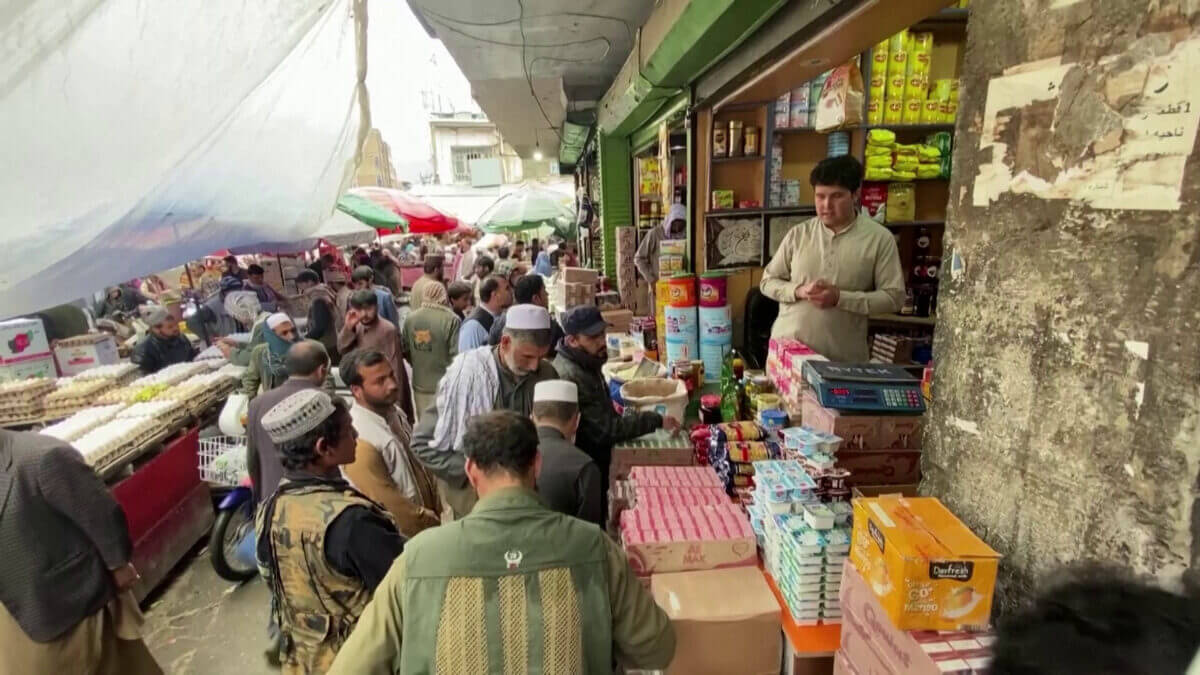 The World Food Programme (WFP) has reported that Afghanistan’s markets remained relatively stable during the first two weeks of June.
According to the report, the Afghan currency weakened slightly against the US dollar, reaching 64.1 afghanis per dollar.
Despite the decline, the afghani remains 8% stronger than a year ago and nearly 15% stronger than the three-year average, helping to contain inflationary pressures to some extent.
Economic analyst Sair Quraishi said the stability of the afghani against foreign currencies is mainly due to better monetary management by the central bank.
“The main reason for the afghani’s stability against the US dollar over the past two to three years has been the central bank’s improved management and control of the money supply. In addition, the inflow of foreign currency into the country and the increased use of the afghani in domestic transactions have played an important role in preserving the value of the national currency and preventing sharp fluctuations in the exchange market,” he said.
The report noted that the relative market stability has been supported by agricultural harvests, increased seasonal supply, and steady regional trade flows, all of which have contributed to the availability of basic commodities.
However, the WFP warned that dependence on imports, rising transportation costs, and regional uncertainties continue to leave markets vulnerable to external shocks.
In the food sector, prices of most essential commodities, including wheat, rice, sugar, and cooking oil, have increased, while the prices of pulses and bread have declined.
Sayed Mohammad, a resident of Kabul, said: “Food prices are high, there is no work, and the prices of rice, flour, and cooking oil are very high. People cannot afford to buy them.”
Another Kabul resident, Abdul Raziq, said: “We ask the government to control prices. People are poor and there are no job opportunities.”
Meanwhile, the Ministry of Economy says the relative improvement in market conditions and the stability of the afghani are the result of increased domestic production, export growth, and stronger trade ties with regional countries.
Abdul Rahman Habib, spokesperson for the ministry, said: “The stability of the afghani against the dollar, increased production, expanded economic cooperation, the development of trade routes, encouragement of investment, and access to needed goods have all played an important role in meeting market demand and preventing a rise in inflation.”
The WFP also reported that labor market conditions remain weak.
According to the organization, although access to work has improved slightly, daily wages and employment opportunities remain below last year’s levels and the three-year average, indicating continued pressure on households that depend on daily wage labor.
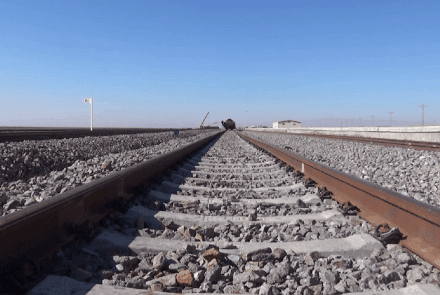 The head of the Iran–Afghanistan Joint Chamber of Commerce says the Herat–Mazar-e-Sharif railway project has entered the implementation phase with the goal of strengthening rail connectivity between Iran, Afghanistan, and Central Asia.
According to Mahmoud Siadat, an agreement for the construction of the railway has been signed between Kabul and Tehran. Once completed, the project could reduce Afghanistan’s dependence on existing export routes and provide more direct access to the markets of Uzbekistan and Tajikistan.
He also emphasized that part of the project’s financing will be secured through Afghanistan’s mineral resources.
Afghanistan’s private banks had previously announced plans to invest nearly 55 billion Afghanis in the project.
The Ministry of Public Works has also described the railway as one of the country’s most important rail corridors for connecting Afghanistan with regional countries.
Mohammad Ashraf Haqshenas, spokesman for the ministry, said: “The Herat–Mazar-e-Sharif railway is one of Afghanistan’s most important economic corridors. It will not only connect the country’s northern provinces but also link Iran and Türkiye, through Afghanistan, to Central Asian countries and ultimately to China.”
Economic experts say that if implemented, the project could become one of the most significant developments in Afghanistan’s transit and transportation network.
Economic analyst Abdul Ghafar Nezami said: “Afghanistan needs to connect to regional transport networks through major railway infrastructure projects. Completion of the Herat–Mazar-e-Sharif railway will improve access to regional markets and international transit routes while creating broad employment and investment opportunities for citizens.”
The Herat–Mazar-e-Sharif railway will connect Herat in western Afghanistan with Mazar-e-Sharif in the north, paving the way for greater connectivity with Iran, Central Asia, and, in a broader vision, regional transit networks.
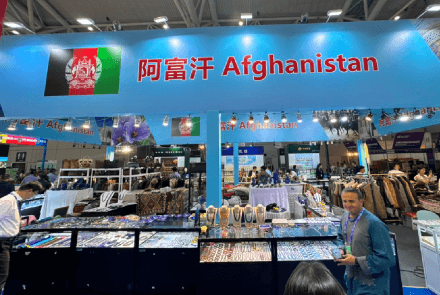 The China–Eurasia Expo 2026 officially opened on Thursday in Urumqi, China, with the participation of Afghan businesses.
More than 30 exhibition booths have been set up by Afghan traders, showcasing a range of products, including carpets, saffron, dried fruits, and precious gemstones.
Afghan exhibitors described the event as an important opportunity to promote the country’s production capacity and expand export markets.
“This exhibition offers significant benefits for Afghanistan’s handicrafts, saffron, and dried fruit industries. Through this event, we can demonstrate to the world the range of products Afghanistan has to offer,” said trader Mohammad Naeem Popal.
Another trader, Hamed Rauf, called on the government to facilitate broader participation by Afghan businesses in future editions of the expo.
“Our request to the government is to create opportunities for greater participation by Afghan traders in the coming years. This year, the number of exhibition booths was limited, and participation costs were high,” he said.
Shahabuddin Saqib, Deputy Minister of Industry and Commerce, is attending the exhibition.
According to the Ministry of Industry and Commerce, Afghanistan’s participation aims to strengthen trade and economic relations, showcase the country’s investment opportunities, and attract foreign investment.
Economic analyst Abdul Hadi Ghazniwal said the Afghan delegation should use the event not only to promote and market Afghan products but also to engage with Chinese officials and companies on expanding economic cooperation, attracting investment, and facilitating technology transfer to support the development of Afghanistan’s production and trade sectors.
The China–Eurasia Expo 2026 is one of the region’s largest trade events. Held annually in Urumqi, it aims to promote economic cooperation, attract investment, and showcase business opportunities across the region.